
Why a trader needs people around: networking as a survival habit
Isolation amplifies biases and turns every loss into a personal drama. Building a network of qualified contacts is not optional: it is mental infrastructure.
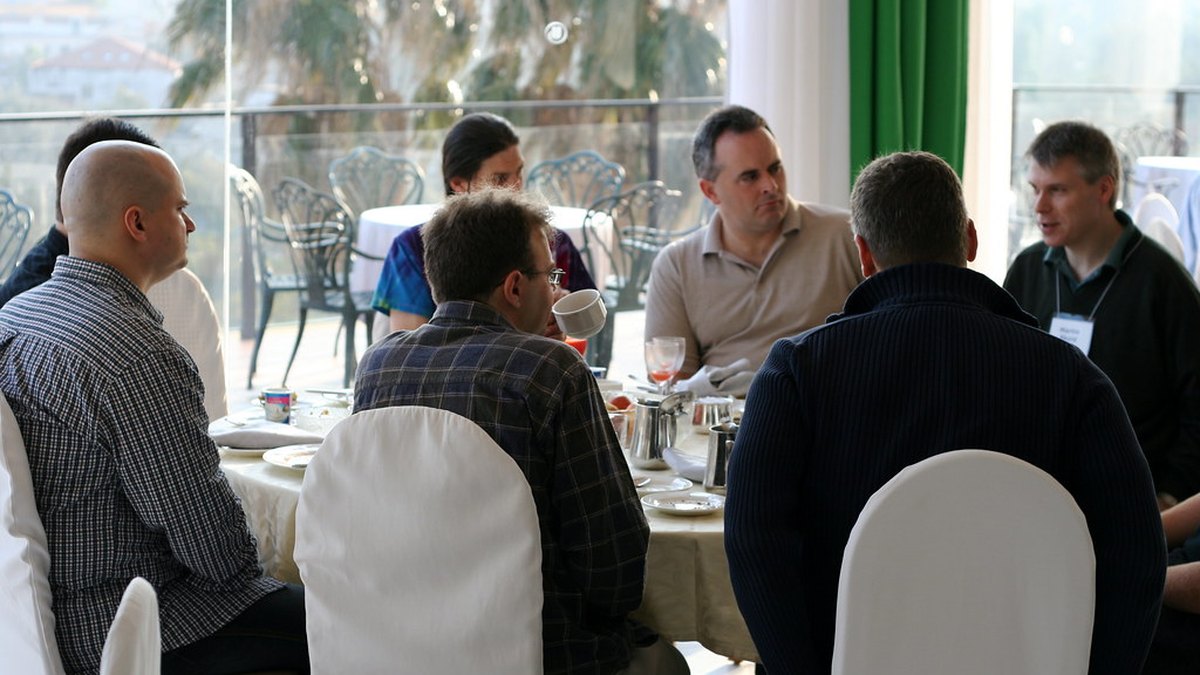
Networking among traders functions as a critical mirror and helps deactivate emotional biases. Photo: jimw · CC BY 2.0 · via flickr
Trading is a solitary activity by design. Screen, platform, decision. But that solitude, taken to the extreme, becomes the trader’s worst enemy: it amplifies biases, turns every loss into a personal drama and eliminates any contrast that helps calibrate reality. Networking—understood as the deliberate construction of a network of qualified contacts—is not a social extra. It is mental infrastructure.
The reason is simple: the market does not provide useful feedback. A winning trade may conceal a process error; a losing one may be the result of an impeccable decision. Without interlocutors who know the craft, the trader is left alone with the noise of their account and the voice in their head. And that combination, sooner or later, distorts.
The echo chamber effect
When a trader spends weeks without discussing the market with anyone who understands, their internal narrative reinforces itself without friction. If they are convinced that “the market is going to turn”, they will seek confirmations in every candle. If they have suffered three consecutive losses, they will begin to doubt their entire system. Without external contrast, the mind becomes an echo chamber.
The network of contacts acts as a critical mirror. It is not about seeking validation, but about exposing one’s reasoning to someone who can point out the blind spot. A fellow professional may ask: “have you checked tomorrow’s data?” or “why do you assume the level will hold?”. Those questions, apparently simple, force one to verbalise the logic and detect inconsistencies that, in solitude, go unnoticed.
Concrete habits for functional networking
Effective networking in trading has nothing to do with accumulating followers or attending mass events. It is about building quality relationships with people who are on the same path or slightly ahead. Three practical habits make the difference.
First: establish a weekly exchange routine with one or two trusted traders. It could be a thirty-minute video call on Sunday afternoons, before the Asian market opens, or a chat group where each person shares their reading of the week. What matters is regularity and honesty. It is not about boasting about successes, but about sharing doubts, errors and reasoning.
Without external contrast, the trader turns every trade into a judgement on themselves, and that contaminates decision-making.
Second: seek informal mentors. A formal agreement or payment is not necessary. It is enough to identify someone with more experience—a trader who has been operating consistently for five years, a retired manager—and propose a monthly conversation. Most professionals are willing to help if the request is specific and respectful. The key lies in preparing concrete questions and demonstrating that their time is valued.
Third: participate in small, well-moderated communities. Mass forums and open social networks are usually pure noise. Private communities—Telegram groups with entry filters, specialised forums with active moderation—allow for higher quality conversations. Here the habit consists of contributing before asking: sharing one’s own analysis, answering others’ questions, pointing out useful resources. That reciprocity builds reputation and opens doors.
Why it works: deactivating emotional bias
Networking is not magic. Its effectiveness resides in two psychological mechanisms. The first is emotional drawdown management. When a trader goes through a losing streak, talking to someone who has been through the same—and come out—restores perspective. It does not eliminate the pain, but it does remove the sense of exceptionality. “This is part of the craft” ceases to be an empty phrase and becomes shared experience.
The second mechanism is process externalisation. Explaining out loud why a decision was made forces one to structure one’s thinking. Often, when verbalising, the trader themselves detects the flaw before the interlocutor says anything. That simple discipline of “thinking for another” improves operational clarity.
The risk of isolation: when the ego takes command
The trader who operates in total solitude ends up relating to the market as if it were a personal battle. Every stop loss becomes a defeat, every gain a victory for the ego. That dynamic is unsustainable. The market does not know who you are and does not care. Trading well requires treating each operation as an independent event within a probabilistic system, and that is almost impossible without a support network.
Moreover, isolation reinforces the overtrading trap. Without anyone to ask “why did you open that?”, the trader multiplies impulsive entries. The network acts as an anchor: knowing that decisions will have to be explained introduces a reflective pause before executing.
What to watch for
Networking requires investment of time and energy, but the return—in terms of mental clarity and longevity in the market—is difficult to measure and easy to underestimate. The key lies in starting small: a monthly conversation, a group of three people, a mentor to write to once a quarter. The network is built slowly, but its absence is noticed quickly.
Notice: informational content. Trading and investments carry risk of loss, including total loss of capital. This is not investment advice.
Related · Onyqdesk tools
🇪🇸 Versión en español: Por qué un trader necesita gente alrededor: el networking como hábito de supervivencia
What if the next piece reached you before it happened?
Monday to Friday, 1h35 before the New York cash open: the pre-market with levels, the calendar and the trading idea of the day. On Sunday, the weekly wrap and the week ahead. Free. No spam. One click to unsubscribe.


Leave A Comment
You must be logged in to post a comment.